LORD CHERRY’s review
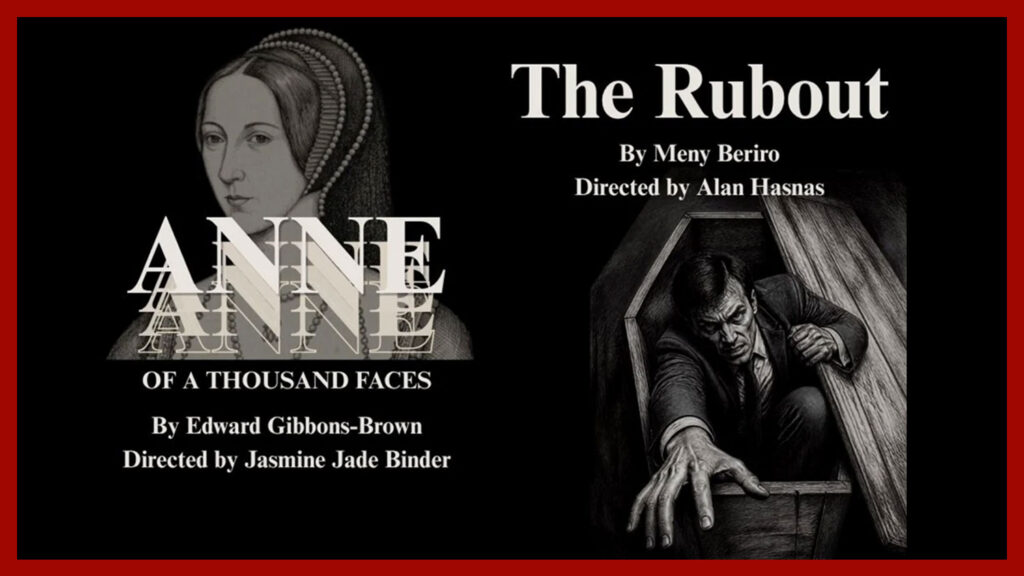
“The Rubout” and “Anne Of A Thousand Faces”
Playwrights & Directors Festival 2026
American Theatre of Actors
Beckmann Theatre
September 2026
Presented as a double feature, “The Rubout” and “Anne Of A Thousand Faces” are two psychological one-act plays linked by complexity, twists and turns, intense emotions, and an underlying dark humour.
Written by Meny Beriro and directed by Alan Hasnas, “The Rubout” follows George Bizzell (Phil Oetiker), a 38-year-long employee of Maloney & Sons Funeral Home. A perpetual yes-man with difficulty setting personal boundaries, he often finds himself working overtime and picking up his boss’ slack, without a significant rise in pay. So when Bill Miller (Alan Hasnas) unexpectedly arrives with an illegal and very morally questionable money-making scheme, the temptation is strong. And, suddenly, nothing is what it seems.
What follows is a play about deceit, doubt, guilt, anger, fairness, and the uniquely human ability to rationalise our own misdeeds in an attempt to protect ourselves from the harm we realistically inflict on others—ultimately allowing ourselves to happily keep our facade of goodness without acknowledging the bad we also do.
Both actors do an exceptional job of effectively portraying the complexity of the human mind through their emotional performances. Oetiker is able to go from anger to sinister to completely guilt-ridden with apparent ease. Hasnas shines as he literally sheds one demeanour, accent, and clothing for another, highlighting his acting range. I only hope to see this expanded into a full play, allowing the audience to truly trust each and every new change as it happens.
Continuing the evening is “Anne Of A Thousand Faces”, written by Edward Gibbons-Brown and directed by Jasmine Jade Binder. This self-aware play centres around an unnamed actress as she auditions for the role of Anne Boleyn in a new Broadway show. We watch the audition process as it brims with themes of financial excess, artificial intelligence, autonomy, humanity, manipulation, intentions, revenge, the patriarchy, womanhood, humiliation, and more.
The hopeful Anne (Bonnie Lawrence) takes the stage, only to notice a number of oddities: a newly revised script, pages out of order, blatant historical inaccuracies in the material, and a strange AI system constantly interpreting every word she speaks and/or action she makes. Reading lines opposite her is the playwright, filling in as King Henry VIII (Edward Gibbons-Brown). The setting is the Tower of London, the night before Anne’s execution. Henry has come to visit her one final time—giving her one last chance to change history and save her life.
The playwright’s assistant, appropriately known only as Chamberlain (Jasmine Jade Binder)—the royal title historically given to those who manage the day-to-day inner workings of a nobleman’s household—is at the computers control. The characters cycle through four different approaches to the scene—and to the historical and societal interpretations of the famously beheaded Queen. Ultimately, the play highlights the complex nature of what it means to be a human, and explores our inability to cleanly separate our authentic emotions from the behaviours and thoughts that are shaped by societal and historical facts and norms. All the while, the AI watches, listens, records, and calculates.
All three actors are phenomenal; everything from awkwardness to fear to strength is palpable in the air. The inclusion of AI is a clever way to layer and drive home the uniqueness of human nature. It also serves as a nice visual representation, as the machine struggles to account for everything that makes up a person’s identity and convictions. If the play has one flaw, it’s simply repetition. After all, much of the show comes down to the point that humans are too complex to separate cleanly into distinct categories without any overlap.
All in all, “The Rubout” and “Anne Of A Thousand Faces” aren’t perfect plays, but they are two thought-provoking, darkly funny, well-acted psychological one-acts exploring humanity and what it means to be human, and they complement each other well.
I decree 4 out of 5 stars.